The wild side: Norway’s herbivore communities are getting wilder

In many parts of the world, wild herbivores coexist with domestic livestock. Direct interactions between wild and domestic herbivores such as competition for forage often occur, as do indirect interactions such as apparent competition through predator densities. However, environmental management of wild herbivores and livestock is usually completely disconnected.

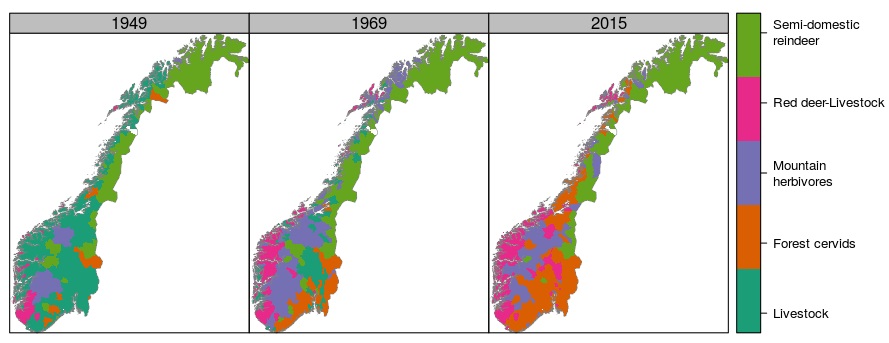
In a newly published paper, James Speed and colleagues analyse densities of wild herbivores and livestock in space (across Norway’s rangelands) and time (from 1949 to 2015). They find that livestock densities have greatly reduced, while wild cervids have increased in density. This is especially strong in milder regions, while mountain and northern regions remain dominated by livestock today (Figure 1).

Figure 1. Change in large herbivore communities across Norway from 1949 to 2015. Note the decline in the livestock assemblage and increase in forest cervids in the south east and central regions. The semi-domestic reindeer assemblage and mountain herbivore communities remain more stable over time.

These changes signify that Norway’s herbivore communities have become wilder – a process known as passive rewilding. However, both livestock and wild herbivores remain under stringent environmental management today. Interactions between wild and domestic herbivores, through both vegetation and predation, indicate that management of livestock and wild herbivores should be more integrated.

You can read the full paper here.

Reference: Speed JDM, Austrheim G, Kolstad AL, Solberg EJ (2019) Long-term changes in northern large-herbivore communities reveal differential rewilding rates in space and time. PLoS ONE 14(5): e0217166

https://doi.org/10.1371/journal.pone.0217166


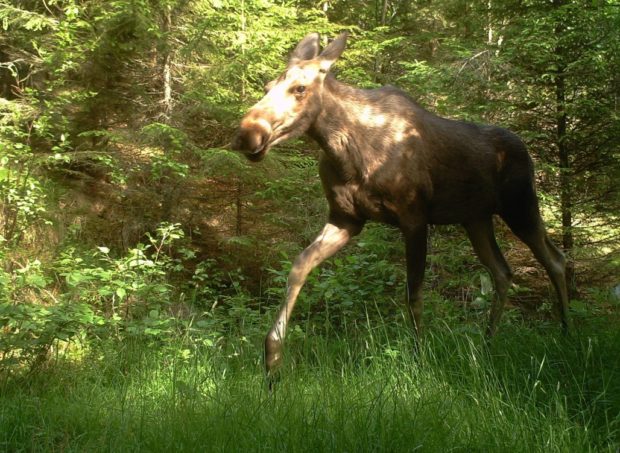
Picture: Moose (Alces alces, European elk) is one of the species that has increased most in density across Norway from 1949 to 2015 (photo: James Speed, NTNU).

Can novel pest outbreaks drive ecosystem transitions in northern‐boreal birch forest?

Herbivores can sometimes alter the trajectory of entire ecosystems. In the northern-boreal mountain birch forest of Northern Fennoscandia, outbreaks by geometrid moths have caused mass mortality of mountain birch across large areas since the early 2000s. The severity of the outbreaks has been linked to the climatically facilitated range-expansion of the winter moth (Operophtera brumata), that has recently established itself as a new outbreaking defoliator in many areas that originally experienced outbreaks only by the native autumnal moth (Epirrita autumnata).

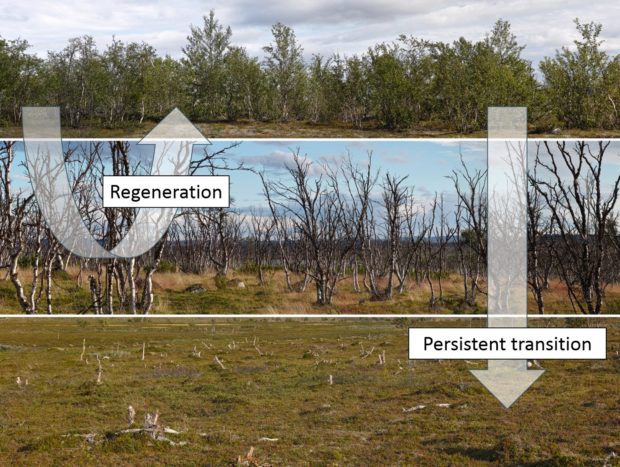
In the current study – focused on the Varanger region in northeast Norway – we show that the cumulative defoliation inflicted by such a novel two-species outbreak has exceeded a critical tolerance threshold (tipping point) of the forest, resulting in an abrupt increase in the mortality rate of birch stems. We also show that this severe mortality event has resulted in the loss of internal positive feedback mechanisms in forest regrowth, as regeneration by both basal sprouting and sapling production are positively affected by the presence of surviving stems and trees. Thus, reforestation may be very slow or fail altogether in areas that have been forced across critical tolerance thresholds and suffered mass mortality of trees. Accordingly, climatically induced alteration of moth defoliation regimes in the mountain birch forest could cause this ecosystem to undergo rapid and potentially persistent changes of state.

You can read the full paper here.

Reference: Vindstad, OPL, Jepsen, JU, Ek, M, Pepi, A, Ims, RA (2019) Can novel pest outbreaks drive ecosystem transitions in northern‐boreal birch forest? Journal of Ecology 107: 1141–1153.

https://doi.org/10.1111/1365-2745.13093


Picture: A conceptual model for how forest mortality induced by moth outbreaks may be followed by regeneration or a persistent transition to a treeless ecosystem state (photo: Jakob Iglhaut).

Reindeer grazing promotes plant phosphorus limitation in arctic tundra

Large mammalian herbivores occur in many terrestrial ecosystems and have large impacts on plant communities. They can for example change the availability of growth-limiting nutrients for plants, such as nitrogen (N) and phosphorus (P). Through this, herbivores might change nutrient limitation of plant growth (between N and P limitation) and thereby impact plant productivity.

Reindeer (or caribou) are important herbivores in arctic tundra and they are known to affect soil nutrient availabilities. In this study we examined the effect of long-term light and heavy reindeer grazing on nutrient limitation of plant growth in a Scandinavian arctic tundra. We performed a fertilization experiment, whereby we added N and P in a full-factorial manner, across the two grazing regimes in heath and meadow vegetation.

The productivity of the plant communities showed contrasting responses to our fertilization treatments under light and heavy reindeer grazing. Under light grazing, productivity increased with N and P additions in both the heath and meadow vegetation. Under heavy grazing, productivity increased when N was added in the heath, and increased even more when N was added together with P. In the meadow, productivity increased when P was added, either alone or in combination with N.

These results clearly show that heavy and long-term grazing by reindeer promoted P limitation of plant communities in both the heath and meadow vegetation. The mechanisms behind the shift towards these conditions were not the same in both vegetation types. In the N-poor heath, reindeer increased soil N availability due to a shift towards more N-rich graminoids, while in the meadow reindeer decreased soil P availability. It remains unclear how reindeer decrease soil P, but they may simply export more P from the system than N due to their large P demand for the production of their antlers.

In this study, we have experimentally confirmed that heavy grazing by large mammalian herbivores for a long time has the potential to change nutrient limitation of plant growth. Such a change can have significant ecological impacts, including changes in plant species composition and success of alien plant species.

You can read the article here.

Reference: Sitters, J., Cherif, M., Egelkraut, D., Giesler, R., Olofsson, J. (2019) Long‐term heavy reindeer grazing promotes plant phosphorus limitation in arctic tundra. Functional Ecology

https://doi.org/10.1111/1365-2435.13342


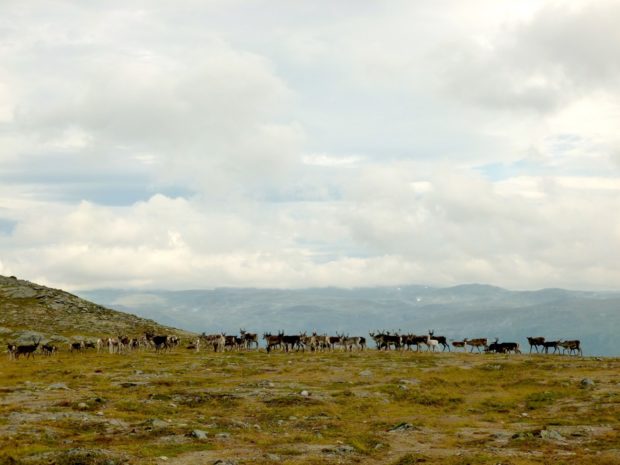
Picture: Herd of reindeer on the heavily grazed side of the fence in Reisadalen, Norway (photo: Judith Sitters)

Trophic interactions and abiotic factors drive functional and phylogenetic structure of vertebrate herbivore communities across the Arctic tundra biome

It is important to understand how biotic communities are organized, because that will determine how they respond to environmental changes. Beyond the number of species present in a community, two other aspects of diversity can provide useful information about the processes of community assembly. These aspects include how species are related to each other (phylogenetic diversity) and how similar they are in the ecological functions they perform (functional diversity).

In this study we investigate how different factors influence the phylogenetic and functional diversity of vertebrate herbivores across the Arctic tundra biome. We chose this group of organisms because herbivores play key ecological roles in tundra ecosystems. In turn, these ecosystems are likely to change substantially in response to the rapid environmental changes in this region. For example, ongoing warming and the northward expansion of boreal species could change the structure of herbivore communities in the Arctic. Further, Arctic vertebrate herbivore communities include species as functionally dissimilar as migratory, social grazers and solitary resident browsers, and as phylogenetically dissimilar as geese and ruminants.

We found that the functional and phylogenetic diversity of herbivore communities in the Arctic are driven by both bottom‐up and top‐down trophic interactions, as well as climatic severity. Under future warming and northward movement of predators, herbivore communities may become more phylogenetically and functionally diverse, with consequences to the functioning of tundra ecosystems.

Reference: Speed, J.D.M., Skjelbred, I.A., Barrio, I.C., Martin, M.D., Berteaux, D., Bueno, C.G., Christie, K.S., Forbes, B.F., Forbey, J., Fortin, D., Grytnes, J.A., Hoset, K.S., Lecomte, N., Marteinsdóttir, B., Mosbacher, J.B., Pedersen, A.O., Ravolainen, V., Rees, E.C., Skarin, A., Sokolova, N., Thornhill, A.H., Tombre, I., Soininen, E.M. (2019) Trophic interactions and abiotic factors drive functional and phylogenetic structure of vertebrate herbivore communities across the Arctic tundra biome. Ecography

https://doi.org/10.1111/ecog.04347

You can read the full article here.


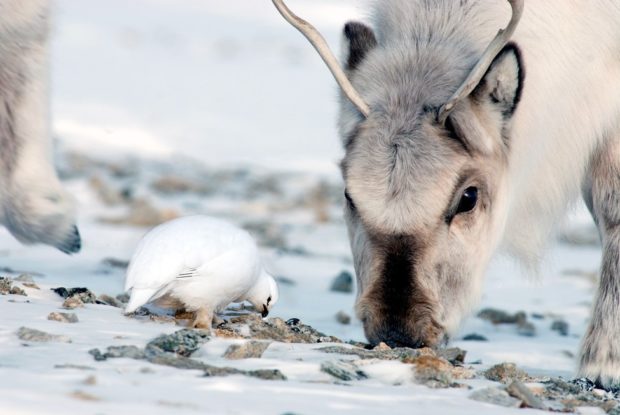
Picture: An example of a phylogenetically diverse herbivore assemblage, with a Svalbard reindeer and a rock ptarmigan (photo: N. Lecomte, University of Moncton, 2019)

Biases in studies of spatial patterns in insect herbivory

Science is suffering a reproducibility crisis that is associated with the impacts of many biases on the outcomes of scientific research. Among these biases, those caused by the properties of the human mind are seldom appreciated by scientists working in the fields of ecology and environmental science. In the present paper, we asked to what extent studies of spatial patterns in insect herbivory suffer from various biases. We answered this question by comparing the outcomes of studies that have used methods of data collection which were potentially prone or not prone to particular biases. This comparison was conducted by meta-analysis of 125 scientific paper containing data on plant losses to insects in different environments. We found that biases emerged when scientists non-randomly selected one or a few plant species when assessing community-wide herbivory or when  scientists did not apply randomisation procedures when selecting leaves for measurements of herbivory. The reported effects were greater when the persons that collected samples and measured leaf damage were aware of the research hypothesis or sample origin than when the collectors/measurers were blinded to these factors. We conclude that our present-day knowledge regarding differences in insect herbivory between environments is considerably biased due to an unconscious tendency of researchers to find support for their hypotheses and expectations, as this generally leads to overestimation of the effects under study. These cognitive biases can be avoided by (i) applying randomisation procedures in sampling and (ii) blinding of the research hypotheses and sample origins. These measures should be seen as obligatory; otherwise, accumulation of biased results in primary studies can ultimately lead to false general conclusions in subsequent research syntheses.

Reference: Zvereva, E., Kozlov, M.V. (2019) Biases in studies of spatial patterns in insect herbivory. Ecological Monographs.

https://doi.org/10.1002/ecm.1361

You can read the full article here.


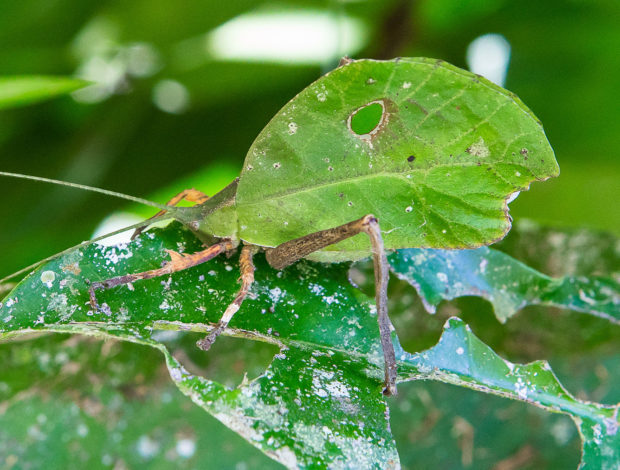
Picture: A tropical herbivore (bush cricket) mimicking leaf with insect damage (photo: V. Zverev, 2019)

PhD position in Trondheim

We are excited to announce a PhD position available at the Norwegian University of Science and Technology (Trondheim) Department of Natural History. Please share with potential applicants!

The project will study the functional and phylogenetic basis of trophic interactions at large spatial scales. The position has a start date of August 2019 and application deadline of 10th April. Applications are welcome from candidates with a master degree in biology focussing on ecology, biodiversity or related fields (including those who expect to have completed their degree before August 2019).

More information regarding the position and how to apply can be found in the following link:

https://www.jobbnorge.no/en/available-jobs/job/167096/phd-position-in-ecology-and-spatial-phylogenetics

Please contact James Speed for further information.

Isotope ecology detects fine-scale variation in Svalbard reindeer diet: implications for monitoring herbivory in the changing Arctic

Svalbard reindeer females

In this study, Lily Zhao and colleagues use carbon and nitrogen stable isotope analysis to infer summer dietary differences of Svalbard reindeer found in different valleys. Through regression models, they were able to predict how reindeer dietary intake depend on climatic variables, with July temperature being the strongest predictor.  Using stable isotope analysis, they found robust dietary differences between and within reindeer populations separated by less than 50 km in the proportions of non-mycorrhizal vascular plants and mosses. These localized differences in forage availability related to the onset of the growing season as shown through the onset of the growing season in each valley through time. Overall, this publication provides evidence that carbon and nitrogen stable isotope analysis can detect dietary shifts over short time periods and at fine spatial scales, which means that isotopic studies can help monitor herbivory in the changing Arctic.

Reference: Zhao, L.Z., Colman, A.S., Irvine, R.J. et al. (2019) Isotope ecology detects fine-scale variation in Svalbard reindeer diet: implications for monitoring herbivory in the changing Arctic. Polar Biology.

https://doi.org/10.1007/s00300-019-02474-8

You can read the full article here.


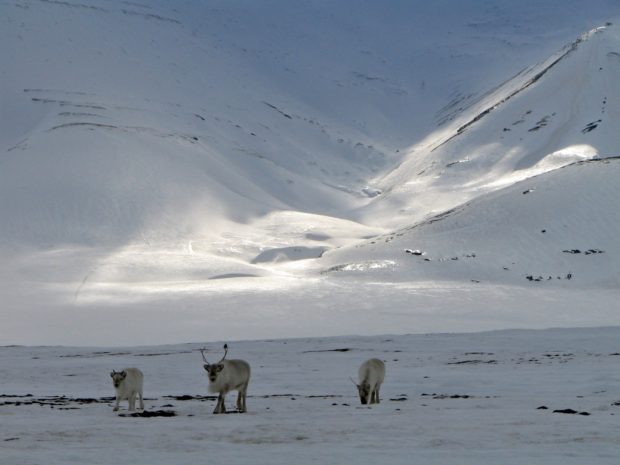
Picture: Couple of Svalbard reindeer females and calf in April
(photo: Justin Irvine)

Call for collaboration on a systematic map on herbivory

Some of you may be familiar with the Herbivory Network project “systematic map of arctic herbivory”. After publishing a “protocol for systematic map” we are now inviting all HN members to co-author the systematic map publication. To join the co-author team you will need to do about a week of work – including i) few days on various small tasks such as scoring papers for inclusion/exclusion, doing searches on various databases, extracting data from papers, and ii) commenting on the manuscript. We will also have a session at the HN meeting in September to work on data analysis/manuscript.

If you are interested in contributing to this effort, please get in touch with Eeva Soininen (eeva.soininen@uit.no).

Short intro to the project

In general, the effects of herbivores on plants and ecosystem functioning depend on the ecological context where the interaction takes place. For example, plants can respond to herbivory differently depending on local soil conditions such as fertility or salinity. Yet, research on herbivory in tundra environments has, until recently, been surprisingly local in extent. The conclusions of local studies on herbivory are thus inevitably affected by the ecological context of the study. Hence, to what extent the current research covers possible ecological contexts is an essential determinant of the general conclusions that can be drawn about the role of herbivory for arctic ecosystems change. Furthermore, the robustness of such conclusions is also pending on the coverage of the underlying ecological contexts. The main idea is to map the ecological contexts in which herbivory has been studied in the Arctic. By understanding which ecological contexts have been more studied and which are underrepresented, we will be able to draw a more robust picture of the effect of herbivory in tundra ecosystems and its variability, given current and past research efforts and the available evidence.

Professor/Associate Professor in Vegetation Ecology

Vacancy: University of South-Eastern Norway

The Faculty of Technology, Natural Sciences and Maritime Sciences has a vacant permanent position as Professor/ Associate Professor in Vegetation Ecology from 01.08.2019.

The position is attached to the Department of Natural Sciences and Environmental Health and reports to the Head of Department. The place of employment is Bø in Telemark, a small town in beautiful surroundings, within two hours travel of Oslo.

https://www.jobbnorge.no/ledige-stillinger/stilling/163776/professor-associate-professor-in-vegetation-ecology

PhD student position in Gothenburg

Robert Björk is looking for a PhD student to join his team at the University of Gothenburg to work within the project ‘Importance of trophic interactions for mycorrhizal dynamics across the Arctic’ funded by the Swedish Research Council. 

The project will use long-term herbivore exclusion experiments at multiple sites across the Arctic to assess how herbivory affects soil fungal communities and the role of ericoid and ectomycorrhizal shrubs in ecosystem carbon dynamics in the Arctic.

You can read more about the project and how to apply here.

Deadline for applications is February 28, 2019.