Extreme weather events pose significant energetic challenges to large herbivores, and the Arctic is warming faster than almost anywhere else on Earth. As a consequence, storms are intensifying and becoming more frequent across the region. Despite this, we know surprisingly little about how Arctic ungulates adjust their behaviour in response to high winds and episodic storm events and what the consequences might be for individual energy budgets and population performance.
This study used over a decade of GPS tracking data from 61 adult muskoxen in northeast Greenland, combined with data on wind speed, precipitation, terrain ruggedness, and vegetation type, to quantify how wind influences movement behaviour and habitat selection across both summer and winter.
As wind speeds increased, muskoxen progressively shifted their time away from foraging and more towards resting. This reallocation of the time-activity budget was most pronounced during wet summer conditions, likely because rain compromises the insulating properties of their thick coat, raising thermoregulatory costs and making energy conservation especially important. Habitat selection patterns already present under calm conditions: a preference for areas with dense vegetation, became even more pronounced as winds strengthened, suggesting animals were actively seeking shelter rather than simply stopping in place.
During storm-force events, muskoxen spent markedly more time resting and less time foraging or relocating compared to individuals unaffected by the same storms. Crucially, there was no evidence of behavioural compensation in the days following a storm: time-activity budgets returned to pre-storm levels without any apparent increase in foraging effort to offset energy lost during the event.
The findings highlight an important and underexplored link between increasing storm activity and herbivore energy budgets in the Arctic. Understanding how repeated or severe storm exposure translates into effects on body condition, reproduction, and survival will be an important next step for assessing the vulnerability of muskox populations — and likely other Arctic ungulates — to ongoing climate change.
Key takeaway: Muskoxen respond to high winds and storms through a passive energy conservation strategy by bedding down in sheltered, vegetation-rich habitat rather than actively compensating for foregone foraging opportunities. This simple but effective short-term strategy may, however, carry cumulative energetic costs if storms become more frequent or prolonged under future climate scenarios.
Reference: van Beest, F.M., Hansen, L.H. & Schmidt, N.M. (2026) Riding out the storm: Behavioural responses of a large herbivore to high‑Arctic winds. Journal of Animal Ecology. DOI: 10.1111/1365-2656.70281
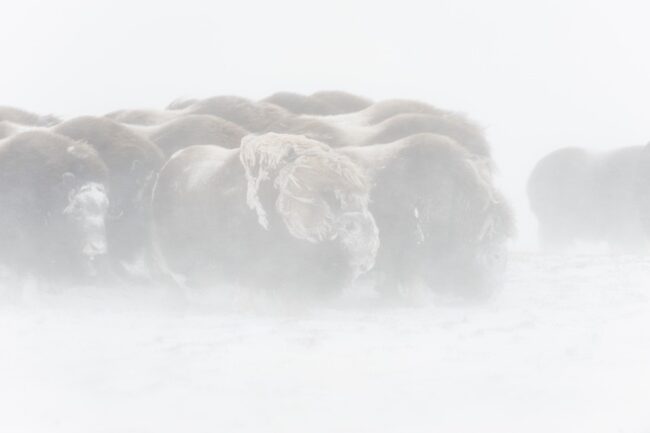
Photo: Muskoxen riding out a snowstorm in Zackenberg valley, northeast Greenland
© Lars H. Hansen