Insect
herbivory is a significant source of plant stress and, due to climate change,
the herbivory stress is continuously increasing. In the Arctic, where climate
warming proceeds with the rate twice of the global average, insect herbivory
stress to vegetation is expected to become more severe. In response to
herbivory, plants produce specialized metabolites to fulfil physiological and
ecological functions, which include volatile organic compounds (VOCs). VOCs are
highly reactive and play an important role in biosphere-atmosphere
interactions. Various biotic and abiotic stressors, including insect herbivory,
can enhance and/or induce the production of many VOCs and alter the composition
of the overall VOC blend emitted from the plants.
Due to lack
of the empirical studies in the Arctic, it is unclear how the effects of insect
herbivory and changing climate such as warming and increased cloudiness, which
are both predicted conditions for the future Arctic, will affect VOC emissions
in the changing Arctic.
Therefore,
in this study we assessed how experimental manipulations of temperature and
light availability in subarctic tundra, that had been maintained for 30 years
at the time of the measurements, affect the VOC emissions from a widespread
dwarf birch when subjected to herbivory by local geometrid moth larvae, the
autumnal moth and the winter moth.
Our study
showed that whether the future subarctic tundra in Northern Fennoscandia
experiences rising temperatures or increasing cloudiness, and therefore milder
temperature increases, matter very little for herbivory-related VOC emissions.
Under both conditions, we showed strong interactions with herbivory effects on
VOC emissions with potentially positive feedbacks on cloud formation. We also
show that acclimation of plants to long-term climate treatments, which has
resulted in changes in anatomical traits, might strongly interact with volatile
responses to insect herbivory. This finding further complicates predictions of
how climate change, together with interacting biotic stresses, affects VOC
emissions in the Arctic.
Full article here: https://doi.org/10.1111/gcb.15773
Reference: Rieksta, J., Li,
T., Michelsen, A., & Rinnan, R. (2021). Synergistic effects of insect
herbivory and changing climate on plant volatile emissions in the subarctic
tundra. Global Change Biology, 27(20), 5030-5042.
Text: Jolanta Rieksta, University of Copenhagen.
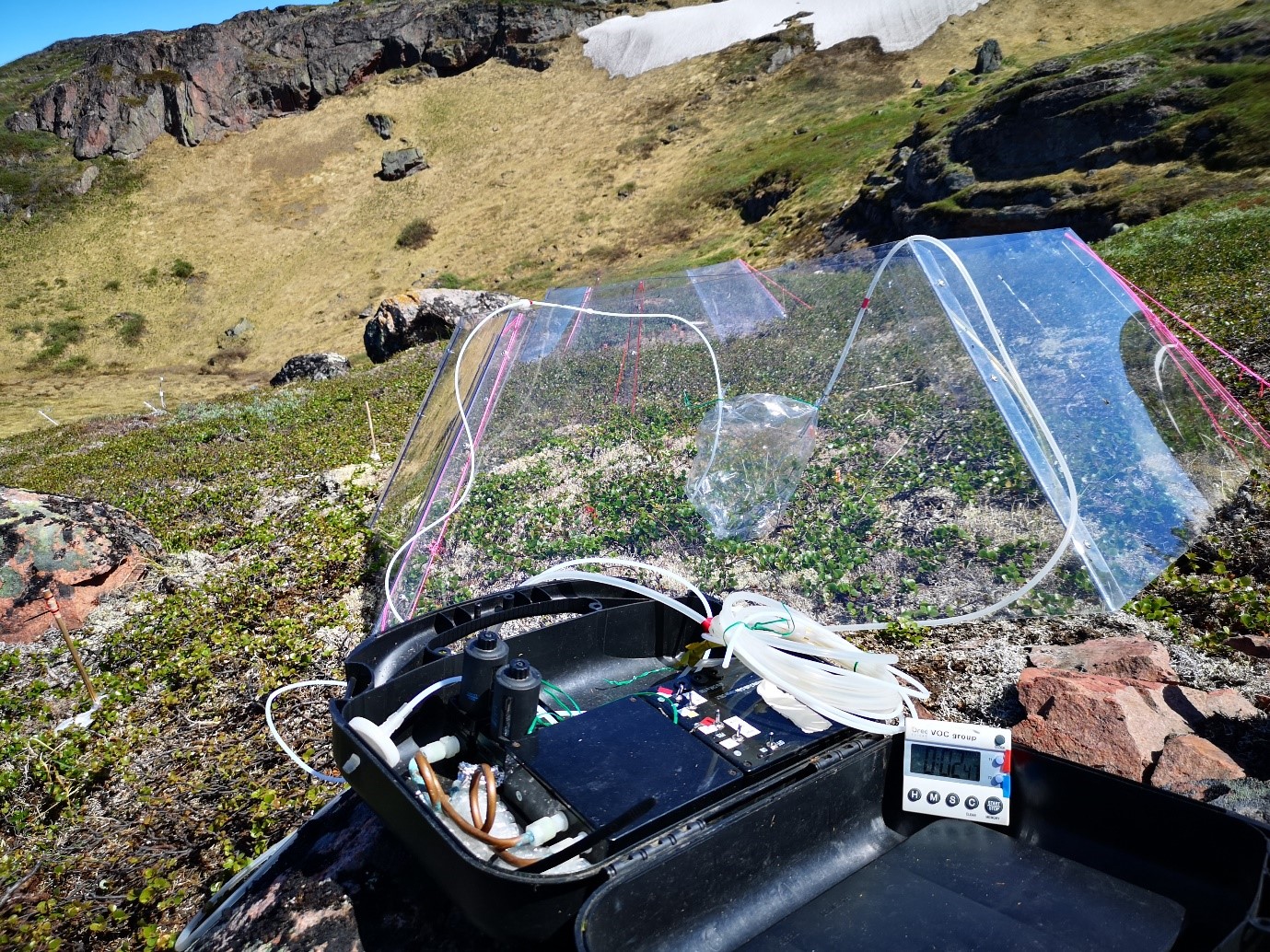
Picture: Measuring volatile organic compound (VOC) emissions from dwarf birch in the field using branch enclosure method where VOC are collected using custom built pull-push systems. (Photo: Jolanta Rieksta).