The TUNDRAsalad team keeps growing

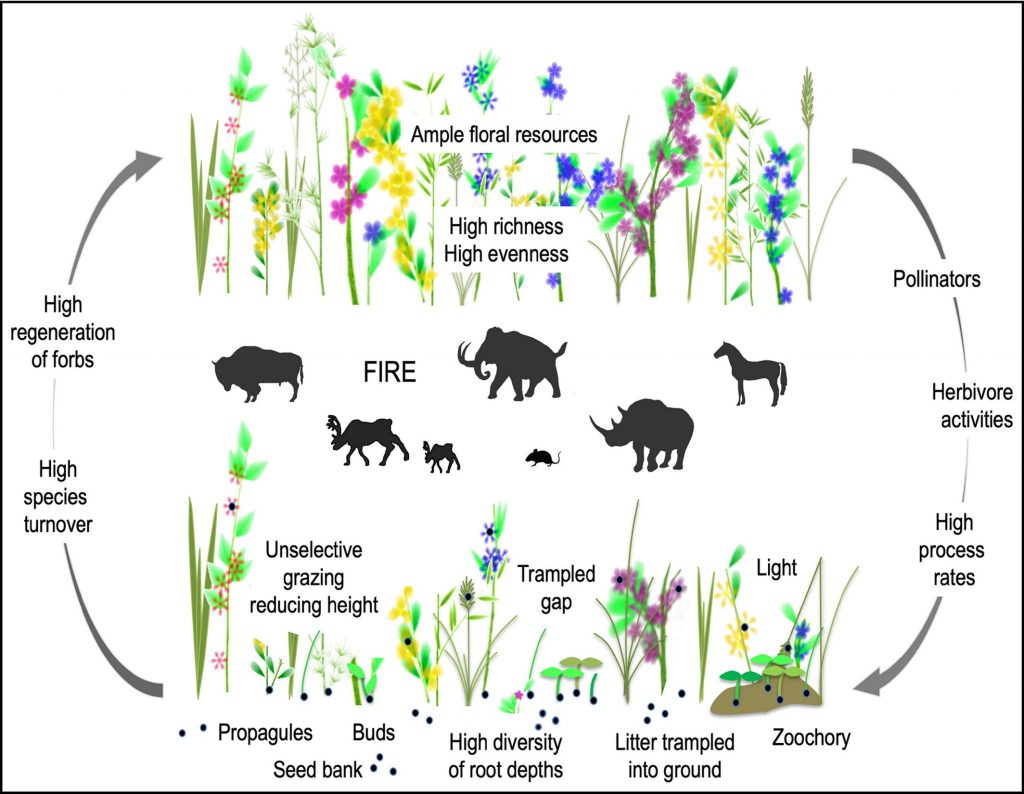
We are very happy to welcome Laura Barbero Palacios to the TUNDRAsalad team! Laura arrived in Iceland in July, and for the next 12 months she will be working on a systematic review on the effects of herbivore diversity on tundra ecosystems. This project is a joint contribution to TUNDRAsalad and the EU-funded CHARTER project.

Laura completed her degree in Biology at the University of Girona and completed a MSc degree in Terrestrial Ecology and Biodiversity Management at the Autonomous University of Barcelona, under the supervision of HN member Emmanuel Serrano. Laura is interested in the role of herbivores as ecosystem engineers, particularly on their effects on biogeochemical cycles. For her MSc thesis Laura conducted a systematic review aimed at synthesizing the effects of large herbivores on biogeochemical models across terrestrial biomes.

Welcome to the TUNDRAsalad team!

Reindeer control over subarctic treeline alters soil fungal communities with potential consequences for soil carbon storage

Arctic grazers are known to prevent the establishment of deciduous shrubs and, under certain conditions, promote the dominance of evergreen shrubs. As these shrubs associate with contrasting soil fungal communities, a grazer-induced shift in shrub abundance could alter the processes sustained by soil fungi – such as soil carbon sequestration. This role of grazers is of particular interest today now that both deciduous and evergreen shrubs are expanding their ranges, and arctic grazer could determine their relative success.

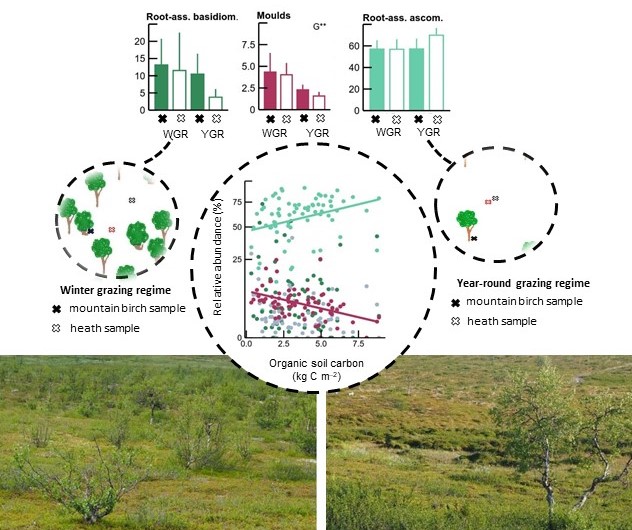
We assessed soil fungal community composition and its links to soil carbon storage in two contrasting long-term reindeer grazing regimes in the subarctic treeline ecotone at the border between Finland and Norway. We found that root-associated basidiomycetes and free-living moulds and yeasts were characteristic to the regime with only wintertime grazing, whereas few taxa of root-associated ascomycota dominated fungal communities on the open heaths in the year-round grazing regime. These patterns in fungal functional guild abundance were linked to organic soil carbon storage: root-associated ascomycetes were more abundant in plots with high soil carbon storage, whereas saprotrophic guilds were typical to plots with low soil carbon storage.

Overall, these findings suggest that when grazers promote the dominance of evergreen dwarf shrubs, they may induce shifts in soil fungal communities that, in the long term, increase soil carbon sequestration. This implies an overlooked role of grazers and grazing regimes in controlling soil carbon storage at the treeline ecotone.

Reference: Ylänne, H., Madsen, R.L., Castaño, C., Metcalfe, D.B. and Clemmensen, K.E. (2021) Reindeer control over subarctic treeline alters soil fungal communities with potential consequences for soil carbon storage. Global Change Biology, pp. 1– 15. https://doi.org/10.1111/gcb.15722


Text by Henni Ylänne, Lund University

Pictures from the two grazing regimes by Henni Ylänne

Reindeer grazing history determines the responses of subarctic soil fungal communities to warming and fertilization

In the Arctic, soil fungal communities may be intrinsically shaped by heavy grazing, which may locally induce an ecosystem change that couples with increased soil temperature and nutrients, and where climate change induced shrub encroachment is less likely to occur than in lightly grazed conditions. Due to these reasons, differences in grazing intensity may control the effects of climate change on fungal communities and thereby carbon and nutrient cycling.

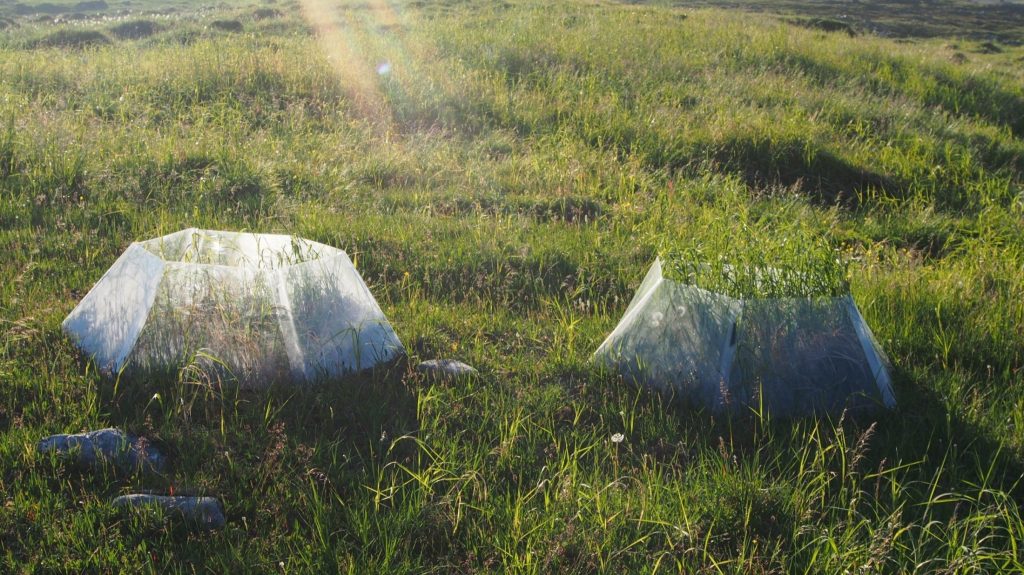
We tested how contrasting long-term grazing intensities affect the responses of soil fungal communities to short-term warming and increased nutrient availability. We used a study design along a reindeer migration route, where 50-years history of an annually occurring pulse of heavy grazing during reindeer migration has shifted the subarctic tundra ecosystem towards increased graminoid dominance, higher soil temperature and nutrient availability. We found that heavy grazing had led to distinct shifts in soil fungal communities when compared to light grazing. Furthermore, the long-term grazing difference largely overrode the effects of short-term warming and fertilization, and the changes in the soil fungal communities caused by our experimental treatments were not unidirectional under different grazing intensities.

Short term warming was simulated using Open-Top Chambers (OTCs). Photo: Henni Ylänne

Our results demonstrate the determinant role of long-term difference in grazing intensity in shaping fungal communities and their responses to abiotic changes. Further, it reveals that if grazing shifts the fungal communities in Arctic ecosystems to a different state, this may dictate ecosystem responses to further abiotic changes. These results incline that the intensity of grazing cannot be left out when predicting future changes in fungi-driven processes in the tundra.

You can read the full article here: https://nph.onlinelibrary.wiley.com/doi/10.1111/nph.17623

Reference: Ahonen, S.H., Ylänne, H., Väisänen, M., Ruotsalainen, A.L., Männistö, M.K., Markkola, A. and Stark, S. (2021) Reindeer grazing history determines the responses of subarctic soil fungal communities to warming and fertilization. New Phytologist.


Text by Saija Ahonen, PhD student University of Oulu

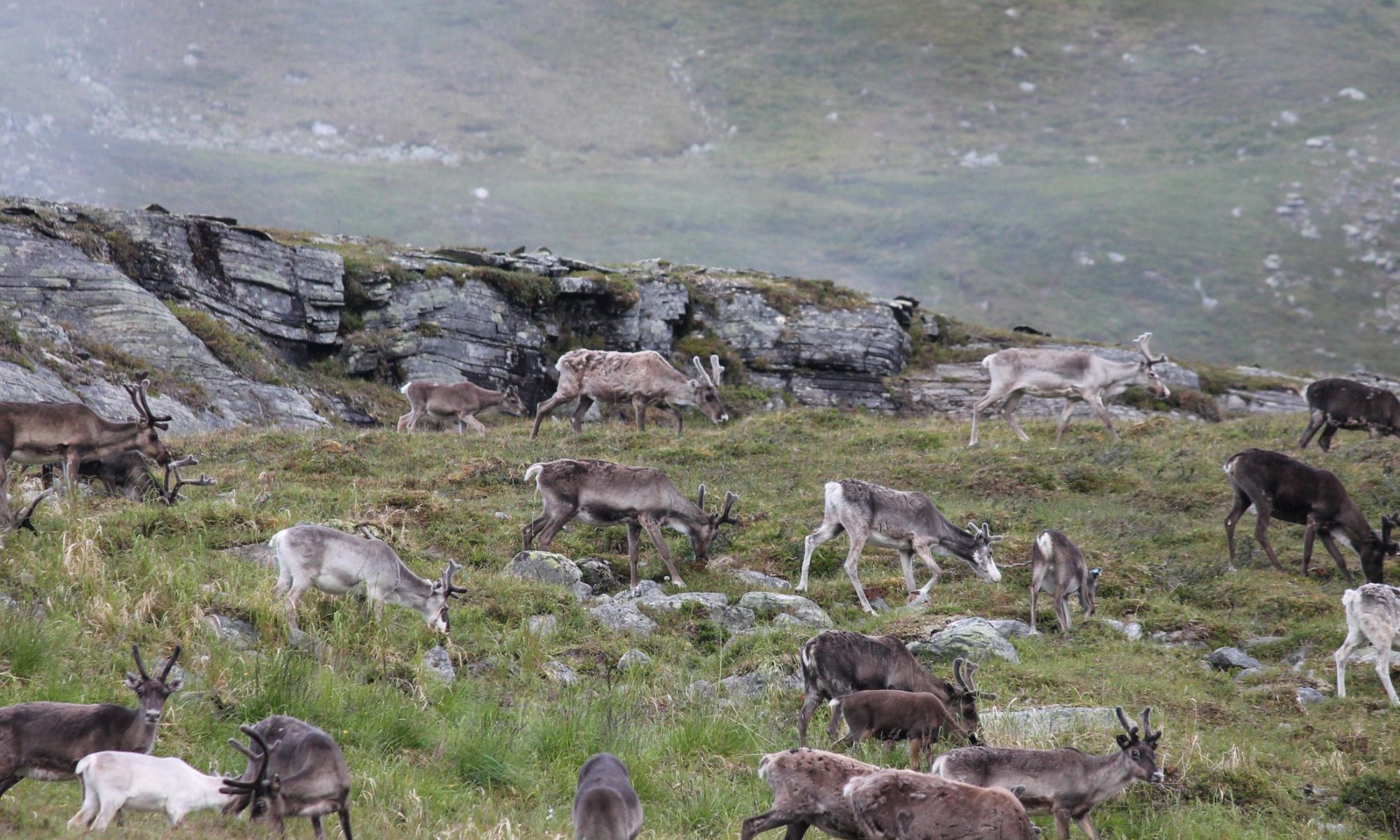
Picture: Reindeer in Ráisduoddar (photo credit Sari Stark)

Identification of data gaps in tundra herbivory research

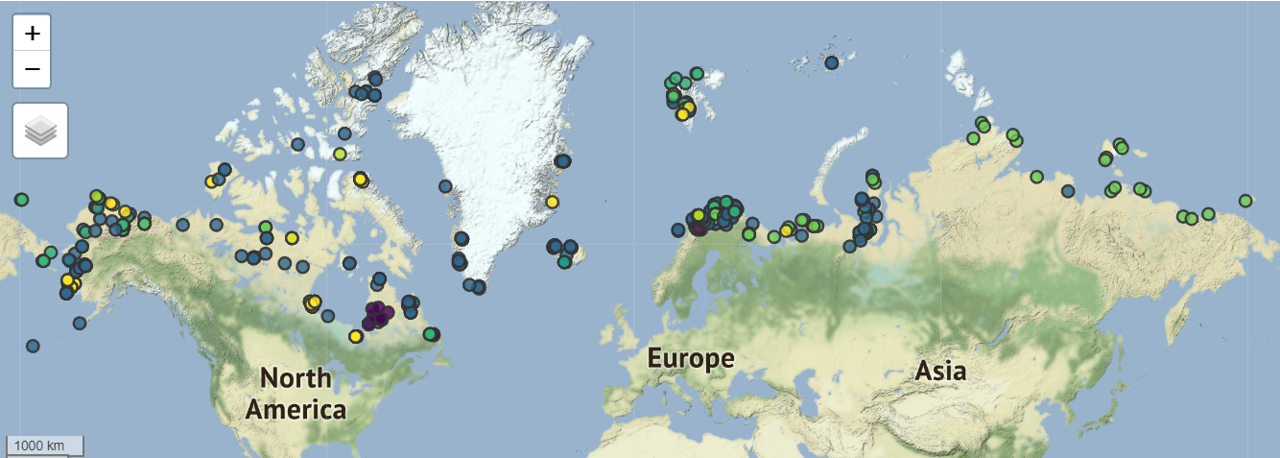
Systematic maps are a tool that allows synthesizing and integrating information to assess what (and how much) has been studied where. The aim of this project was to assess the status of knowledge and current evidence on the effects of herbivores on vegetation in the Arctic. Using a systematic map we were able to identify which environmental contexts can be understood with the current evidence and for which we do not have enough information.

Systematic maps are conducted as two-stage processes: first, a transparent protocol is defined to conduct an unbiased systematic search of evidence, and then the actual systematic map is produced. The first phase of the project received funding from the FRAM Centre and resulted in the publication of the protocol in the journal Environmental Evidence. The next step used the protocol to develop the systematic map. This step was a massive coordination effort led by Eeva Soininen. A large number of collaborators have been involved in this step, which was published in the journal Environmental Evidence:

SOININEN, E.M., BARRIO, I.C., BJØRKÅS, R., BJÖRNSDÓTTIR, K., EHRICH, D., HOPPING, K.A., KAARLEJÄRVI, E., KOLSTAD, A.L., ABDULMANOVA, S., BJÖRK, R.G., BUENO, C.G., EISCHEID, I., FINGER-HIGGENS, R., FORBEY, J.S., GIGNAC, C., GILG, O., DEN HERDER, M., HOLM, H.S., HWANG, B.C., JEPSEN, J.U., KAMENOVA, S., KATER, I., KOLTZ, A.M., KRISTENSEN, J.A., LITTLE, C.J., MACEK, P., MATHISEN, K.M., METCALFE, D.B., MOSBACHER, J.B., MÖRSDORF, M., PARK, T., PROPSTER, J.R., ROBERTS, A.J., SERRANO, E., SPIEGEL, M.P., TAMAYO, M., TUOMI, M.W., VERMA, M., VUORINEN, K.E.M., VÄISÄNEN, M., VAN DER WAL, R., WILCOTS, M.E., YOCCOZ, N.G., SPEED, J. (2021) Location of studies and evidence of effects of herbivory on Arctic vegetation: a systematic map. Environmental Evidence 10:25 link to publisher

Check out also the nice lay summary here.

New PhD student within the TUNDRAsalad project

The TUNDRAsalad team is growing! Mathilde Defourneaux joined the Agricultural University of Iceland in May 2021 to develop her PhD on the effects of spatio-temporal changes of herbivore assemblages on Icelandic tundra ecosystems. Mathilde will investigate how herbivore communities have changed in Iceland over time and what impacts these changes have had on Icelandic ecosystems. She will estimate current impacts of different herbivore assemblages across Iceland and at a finer spatio-temporal resolution, she will assess how herbivore impacts vary at a landscape scale within the growing season. Mathilde’s PhD supervisors are Isabel C Barrio at the Agricultural University of Iceland, Noémie Boulanger-Lapointe at the University of Iceland and James Speed at the Norwegian University of Science and Technology.

Mathilde has an MSc degree in landscape management from Agrocampus Ouest. Before moving to Iceland, Mathilde spent eighteen months in Crozet, Subantarctic Islands, studying the effects of climate change, human activities and introduced species on terrestrial ecosystems, with the programme SubantEco of the French Polar Institute (IPEV). After returning to France, she worked as a technician in data analysis and modelling at the CNRS in Rennes. Among Mathilde’s hobbies are scientific illustration and photography.

Welcome to the TUNDRAsalad team!

Low-elevation range limit of alpine grass species restricted by mammal herbivory

Decades of biogeographic theory suggests that a species geographic range is limited by abiotic conditions towards its high elevation limit and antagonistic biotic interactions towards its low elevation range limit. While many studies have supported the high-elevation range limit prediction, rigorous tests of the low-elevation and antagonistic interaction prediction have been limited. With this work, we tested if three alpine grass species are restricted to the top of the West Elk Mountains, Colorado, USA, in part by higher mammal herbivory rates towards and beyond their low-elevation range limit.

We transplanted individuals of our focal species (Elymus scribneri, Festuca brachyphylla, and Poa alpina) in the core of their range, at their range limit, and in a novel-beyond range limit site that reflected ~2 °C warming. At each site, we factorially excluded above and belowground mammal herbivore access to plants using fencing. Additionally, we collected demographic data from natural populations of the focal species and applied experimental treatment effect sizes to vital rates models (i.e., growth, survival, and reproduction) to project experimental effects on population growth. We found, generally, that herbivory increases from the core of the species’ range towards the limit and novel sites and that restricting above and belowground mammal access to plants increased their growth and reproduction more in limit and novel habitats than in their core range. Additionally, mammal exclusion increased population growth over controls most in limit and novel sites.

Our study suggested that higher herbivory below a species’ elevation range limit contributes to the plant’s exclusion from lower elevations. Importantly, the abiotic environment in novel habitats was hospitable for the individuals, but mammalian herbivory in range limit and novel habitats may drive focal species population growth rates below replacement. Results suggest that as mammals shift their foraging range upslope with further climate change, increased herbivory may drive the local extinction of these alpine restricted grass species.  

You can read the full article here: https://onlinelibrary.wiley.com/doi/epdf/10.1111/ele.13829

Reference: Lynn, J.S., Miller, T.E.X. and Rudgers, J.A. (2021) Mammalian herbivores restrict the altitudinal range limits of alpine plants. Ecology Letters.


Text by Joshua S. Lynn, University of New Mexico.

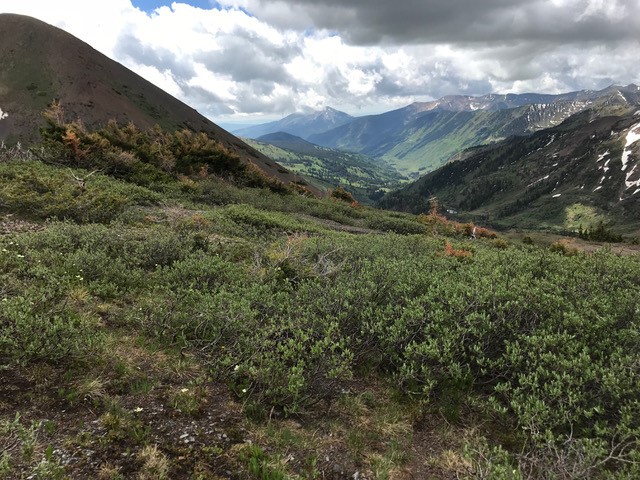
Picture: View of an elevation transect used for the experiment in the West Elk Mountains, Colorado, USA. (Photo credit: Joshua S. Lynn).

Does exclusion of large grazers matter to plant and soil nitrogen in oligotrophic boreal forests?

Oligotrophic boreal forests with lichen dominated field layer are important winter pastures for reindeer (Rangifer tarandus). In addition to the lichen dominated, drier sunlit habitats, these forests may also have moister shaded habitats with varying moss abundance. Mosses, in turn, control vascular plant-soil interactions, yet they all can also be altered by reindeer grazing.

We determined how two decades of reindeer exclusion affects feather moss (Pleurozium schreberi) depth, and the accompanying soil N dynamics, plant foliar N and stable isotopes of N and C in two contrasting habitats of an oligotrophic Scots pine forest. The study species were pine seedling (Pinus sylvestris), bilberry (Vaccinium myrtillus), lingonberry (V. vitis-idaea) and feather moss. We found that moss carpet was 80% deeper after excluding reindeer both in shaded and sunlit habitats. In the humus horizon, the proportion of heavy N isotope increased due to exclusion in the sunlit habitats and, in the mineral soil, exclusion also increased inorganic N in both habitats. These soil responses were correlated with moss depth. Foliar chemistry did not respond to reindeer exclusion and varied solely due to habitat but depending on species identity.

We conclude that despite strong reindeer grazing-induced shifts in mosses and subtler shifts in soil N, the N dynamics of vascular vegetation remain unchanged. These indicate that plant-soil interactions are resistant to shifts in grazing intensity, a pattern that appears to be common across boreal oligotrophic forests.

Reference: Väisänen M, Tuomi M, Bailey H, Welker JM. Plant and soil nitrogen in oligotrophic boreal forest habitats with varying moss depths: does exclusion of large grazers matter? Oecologia

https://doi.org/10.1007/s00442-021-04957-0


Text by Maria Väisänen, University of Oulu and University of Lapland.

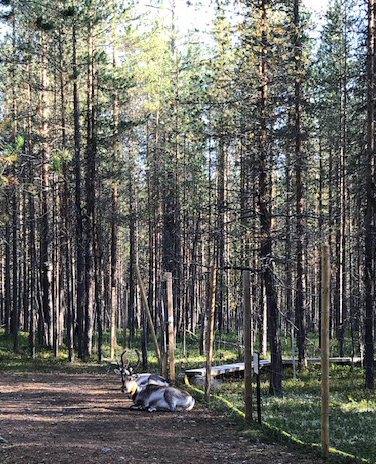
Picture: Reindeer in an oligotrophic Scots pine forest in NE Finland (photo credit: Noora Kantola)

HN fully endorsed as a UArctic TN

The UArctic TN on Herbivory was fully endorsed after a one year period with provisional status, at the meeting of the Assembly of UArctic!

During the year after the initial approval of the HN’s application to become a UArctic Thematic Network, things have been relatively slow due to the COVID pandemic. Still, HN remained active (see the annual report for 2020) and participated in (online) conferences, published several papers including an article in the UArctic Shared Voices magazine, and was able to secure funding for some of its activities.

New TN institutional points of contact

During 2020 six new members were confirmed as institutional points of contact for the TN on Herbivory (Bruce Forbes at the University of Lapland, David Hik at Simon Fraser University, Ingibjörg Svala Jónsdóttir at the University of Iceland, Elina Kaarlejärvi at the University of Helsinki, Mikhail Kozlov at the University of Turku and Johan Olofsson at Umeå
University). The full list of institutional points of contact for the TN on Herbivory includes:

  • Isabel C. Barrio (Lead), Agricultural University of Iceland
  • Bruce Forbes (Member), University of Lapland
  • David Hik (Member), Simon Fraser University
  • Ingibjörg Svala Jónsdóttir (Member), University of Iceland
  • Elina Kaarlejärvi (Member), University of Helsinki
  • Mikhail Kozlov (Member), University of Turku
  • Johan Olofsson (Member), Umeå University
  • Eeva Soininen (Member), UiT The Arctic University of Norway
  • Maria Väisänen (Member), University of Oulu
  • Henni Ylänne (Member), Lund University

If you are working at a UArctic member institution and you want to become an institutional point of contact for the TN on Herbivory, please contact Isabel,

Invertebrate herbivory on shrubs increases in warmer and drier tundra

Rapid warming is predicted to increase insect herbivory across the tundra biome, yet how this will impact the community and ecosystem dynamics remains poorly understood. More insect herbivory could reduce potential gains in Arctic plant growth, by serving as a top–down control on tundra vegetation. Additionally, many tundra ecosystems experience severe insect outbreaks, where large numbers of insects emerge and consume large amounts of leaves and other plant material, which can have leaf lasting damage to shrubs. To explore how tundra-insect herbivore systems respond to warming, we measured shrub traits and leaf herbivory damage at 16 sites along a landscape gradient in western Greenland. Here we show that shrub leaf insect herbivory damage on two dominant deciduous shrubs, grey willow (Salix glauca) and dwarf birch (Betula nana), was positively correlated with increasing temperatures throughout the first half of the 2017 growing season. We found that the majority of insect herbivory damage occurred in July, which was outside the period of rapid leaf expansion that occurred throughout most of June. Leaf-chewing insects caused the most leaf damage in both shrub species. Additionally, insect herbivores removed a larger proportion of dwarf birch leaf biomass in warmer sites, which is due to a combination of increased herbivory with a coinciding decline in leaf biomass. These results suggest that the effects of rising temperatures on both insect herbivores and plants are important to consider when predicting the trajectory of Arctic tundra shrub expansion.  

Reference: Finger-Higgens, R., DeSiervo, M., Ayres, M.P. and Virginia, R.A., 2021. Increasing shrub damage by invertebrate herbivores in the warming and drying tundra of West Greenland. Oecologia, pp.1-11.
https://doi.org/10.1007/s00442-021-04899-7


Text by Rebecca Finger-Higgens, Darmouth College.

Picture: Fieldwork in Kangerlussuaq (photo credit: Rebecca Finger Higgens)